What is EIG (Endurance International Group) and Why You Should Avoid It

If you’ve ever wondered why that popular hosting company you signed up with suddenly started experiencing slow load times, poor customer service, and mysterious price hikes, you might have encountered the hidden influence of one of the web hosting industry’s most controversial players: EIG, or Endurance International Group, now known as Newfold Digital.
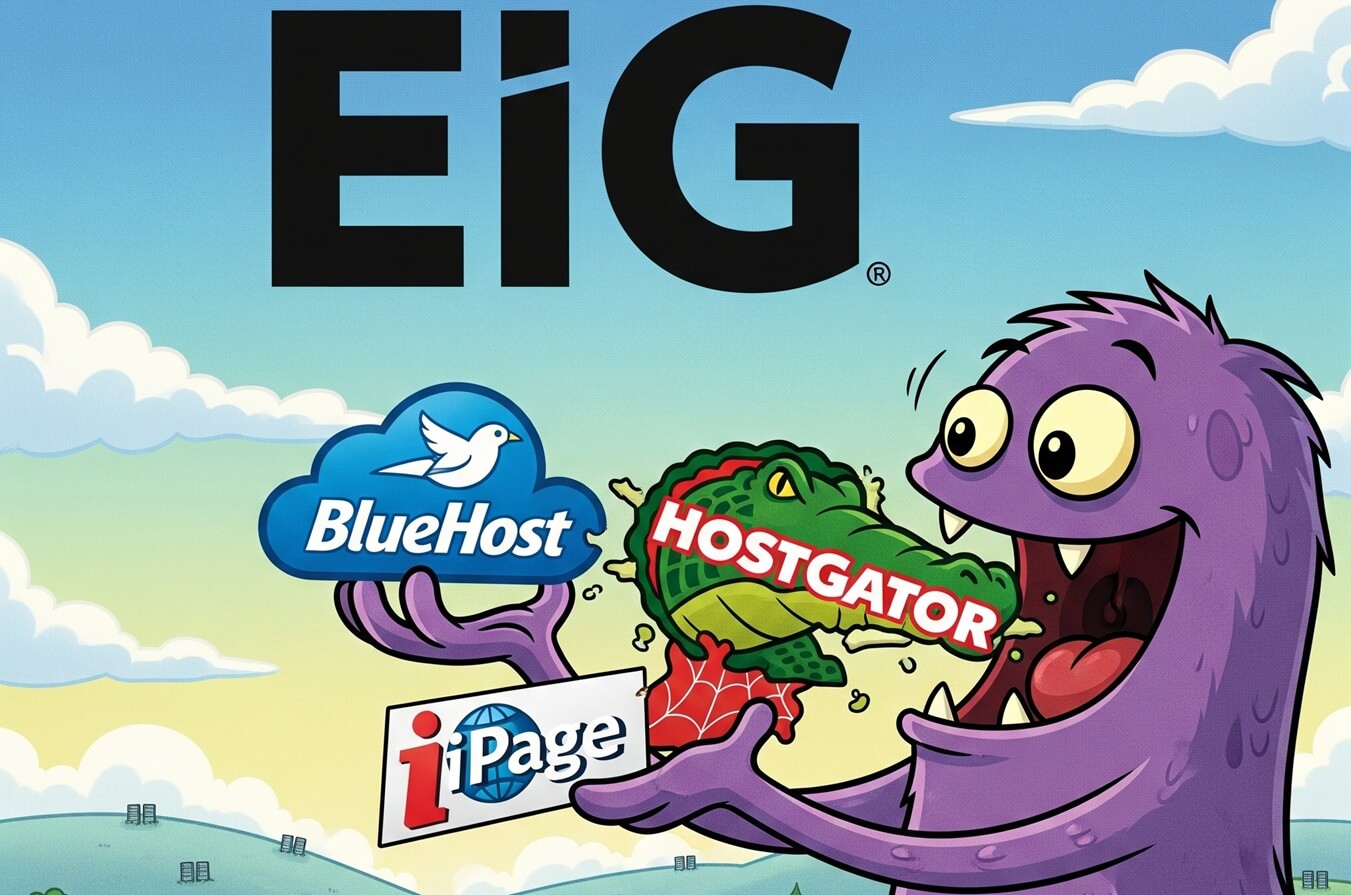
The story of EIG represents everything wrong with consolidation in the web hosting industry. EIG has control of over 60 web hosting brands – which include some of the major players in the hosting business, such as HostGator, BlueHost, HostMonster, iPage, FatCow, JustHost, Arvixe, A Small Orange, and HostNine (Review Hell). What makes this particularly troubling is that most customers have no idea their favorite hosting company has been quietly absorbed into this massive conglomerate.
This comprehensive guide will expose the reality behind EIG’s business practices, document the systematic degradation of beloved hosting brands after acquisition, and help you understand why avoiding EIG-owned hosts is crucial for your website’s success. We’ll explore their corporate strategy of silent takeovers, examine real-world examples of service deterioration, and provide you with reliable alternatives that prioritize actual customer service over profit margins.
Whether you’re a website owner experiencing mysterious performance issues or someone researching hosting options, understanding the EIG story is essential for making informed decisions about where to host your online presence. The implications extend far beyond individual hosting experiences – they represent a broader threat to competition and innovation in the entire web hosting ecosystem.
What is EIG and Their Business Model?
Endurance International Group, Inc. (EIG), previously named BizLand, now part of Newfold Digital, was an IT services company specializing in web hosting. The company was founded in 1997 and headquartered in Burlington, Massachusetts, USA. In 2021 Endurance International Group merged with Web.com forming a new company, Newfold Digital (Wikipedia).
EIG’s business model is fundamentally different from traditional hosting companies. Rather than building their own hosting infrastructure and customer base organically, EIG operates as what industry insiders call a “hosting roll-up” company. EIG focuses on buying web hosting companies which helps them increase their customer base (Review Hell). Their strategy is elegantly simple yet deeply problematic: acquire successful hosting companies, consolidate their operations, cut costs wherever possible, and retain customers who often don’t realize their hosting provider has changed ownership.
EIG’s “about us” page says that it’s “an international family of brands that provides small business owners with the tools they need to establish and build their web presence.” Although it sounds like a similar song and dance to a company like GoDaddy, EIG isn’t actually a web hosting company (Cloudwards). This distinction is crucial – EIG is primarily a financial vehicle that happens to own hosting companies, not a technology company focused on hosting excellence.
The acquisition strategy follows a predictable pattern. Upon acquiring a new hosting business, EIG often makes several notable changes to the business. These changes can include the implementation of their own control panel, migrating accounts to different servers or datacenters, as well as a reduction or complete abolishment of the existing operational staff (Review Hell). This systematic approach allows them to quickly standardize operations across dozens of brands while dramatically reducing operational costs.
What makes EIG’s model particularly insidious is its lack of transparency. EIG often makes these large acquisitions with very little fanfare and it can be argued that they go out of their way to hide this business practice. You won’t find a full list of EIG-owned brands on its website other than some very visible, cherry picked acquisitions that received significant press (Michael Carusi). This secrecy ensures customers remain unaware they’re dealing with a massive conglomerate rather than the independent hosting company they originally chose.

The History of Acquisitions: How EIG Changed Beloved Brands
The EIG acquisition timeline reads like a cautionary tale of consolidation gone wrong. In 1997, Hari Ravichandran — an entrepreneur with an MBA and two degrees in engineering — founded BizLand, a web hosting company focused on small businesses (Cloudwards). Following the dot-com crash, BizLand found it had fallen on hard times. It reorganized — with only 14 employees — into Endurance International Group (Cloudwards).
The real acceleration began when private equity got involved. GS Capital Partners — part of Goldman Sachs and Warburg Pincus LLC — purchased it in 2011. The two investment firms paid $975 million for the company, and after they struck the deal, EIG acquired some of its largest brands, including Bluehost (Cloudwards). This massive infusion of capital transformed EIG from a struggling startup into an acquisition powerhouse.
Some of the most significant acquisitions include:
Bluehost (2010): Once considered the gold standard for WordPress hosting, Bluehost was acquired during EIG’s expansion phase. In 2010, Bluehost was acquired by Endurance International Group (Wikipedia). The acquisition marked the beginning of a noticeable decline in service quality that continues today.
HostGator (2012): HostGator has been in the market for more than two decades now. From a single-owner operation it has today come under the purview of one of the largest forces in web hosting – EIG (ThisBestWebHosting). Long-time customers report dramatic changes after the 2012 acquisition.
Multiple Smaller Brands: We at least know it purchased FatCow in 2005 and IPOWER in 2007. The IPOWER press release from 2007 claims that, at that point, EIG had already acquired 28 other brands (Cloudwards).
The pattern became predictable: EIG would identify successful hosting companies with strong customer bases and loyal followings, acquire them quietly, then systematically change their operations to match EIG’s cost-cutting model. By acquiring smaller hosting companies and folding them into its ever-expanding portfolio of brands, EIG has created a virtual monopoly in the web hosting industry, with few viable alternatives for customers seeking refuge from its grasp (ThisHosting.Rocks).
What’s particularly troubling is how these acquisitions often occurred without customer notification. Many users discovered their hosting company had been sold to EIG only when they encountered problems and noticed changes in support quality or billing practices.

Customer Problems After EIG Acquisitions
The deterioration following EIG acquisitions isn’t anecdotal – it follows a consistent, documented pattern across multiple brands and timeframes. Industry observers and customers have chronicled the same issues repeatedly across different acquired companies.
Performance Degradation
Every time EIG buys a new hosting company, people report the same problems: Professional customer support teams are replaced with cheaper, slower options. Fast server hardware is replaced with cheaper, slower hardware (Website Planet). This isn’t speculation – it’s a business strategy designed to maximize profits from existing customer relationships.
One of the most egregious sins of EIG is its propensity for overselling server resources. In pursuit of ever-greater profits, EIG packs its servers to the brim, cramming as many websites onto each machine as possible. The result? A digital slum where websites jostle for meager scraps of bandwidth, leading to sluggish load times, unexplained outages, and an overall subpar user experience (ThisHosting.Rocks).
Real-world examples abound. For example, Vodien’s server web107 has been consistently running at four times its ideal maximum capacity (Netcat.au). This level of overselling would be unthinkable for quality hosting providers who monitor server loads and maintain appropriate capacity ratios.
Customer Service Decline
The support experience changes dramatically after EIG acquisitions. Unfortunately, one of the first cuts made after Newfold Digital/EIG acquires a company is the original support team, with roles being offshored to developing countries with minimal training offered (Netcat.au). This isn’t just cost-cutting – it’s a fundamental change in how customer service is prioritized.
Since 2013 HostGator had experienced a steady, saddening decline in website speed, uptime and service quality. Chat support reps seemed less knowledgeable, some of them spoke in broken English and others needed to be asked questions several times to get clear answers (Michael Carusi).
The impact extends beyond language barriers. You may find representatives who don’t speak fluent English, and this can be difficult at times. Also, if the main concern is hiring the lowest-paid support, you can’t expect them to be experts (Googiehost). When technical issues arise, customers find themselves dealing with undertrained representatives following scripts rather than knowledgeable technicians who can solve complex problems.
Price Increases and Feature Removal
EIG’s pricing strategy reveals their true priorities. Pricing went up, but value dropped. In some cases, renewal prices doubled or tripled while service quality declined. Brands like Bluehost and HostGator were frequently criticized for upselling features like backups, email, and malware scanning – features that were once included by default (HostScore).
This represents a fundamental shift in value proposition. Features that were once standard become premium add-ons, while renewal prices increase dramatically. After your first year, your $65.40 Choice Plus plan renews at an eye-watering $263.88. This has lead to bill shock! (Netcat.au)
Security Vulnerabilities
Instances of security breaches and data leaks are disturbingly common occurrences across EIG’s sprawling network of hosting brands. From Bluehost to HostGator, iPage to Constant Contact, no corner of EIG’s empire is immune from the threat of cyberattacks and data breaches (ThisHosting.Rocks).
Specific incidents include major breaches affecting multiple brands simultaneously. In March 2015, Bluehost was hacked by the Syrian Electronic Army. Also hacked were Justhost, Hostgator, Hostmonster and Fastdomain, all owned by Endurance International Group (Wikipedia). When security breaches affect multiple “independent” brands simultaneously, it reveals the shared infrastructure that makes EIG’s cost-cutting possible.
Real-World Examples of Brand Deterioration
HostGator: From Industry Leader to Customer Frustration
HostGator provides perhaps the clearest example of EIG’s impact on a once-excellent hosting provider. For years and years I supported them. In fact, years ago if you would have told me you didn’t like them I would have looked at you like you were a crazy person (ThisBestWebHosting).
The transformation was dramatic and measurable. Their service was top notch and I bragged about how knowledgeable their tech support was. After dealing with several other hosting companies through my clients such as Bluehost and GoDaddy, I truly felt that Hostgator couldn’t be beat for Shared hosting (ThisBestWebHosting).
Then came the acquisition, and everything changed. I was warned in web hosting circles that everything would change after Hostgator was bought out by EIG but I didn’t believe all the rumors and I continued to receive great service….until I saw major changes about 1.5 years ago. Quickly I was waiting for tech support either on chat or on the phone for over an hour (even though the message on screen only said 30 minute wait….but frozen there the next 30 minutes) instead of 3 minutes a few months prior (ThisBestWebHosting).
Bluehost: The WordPress Community’s Former Darling
Bluehost once held a privileged position as an officially recommended WordPress hosting provider. However, post-acquisition performance tells a different story. A prime example is Bluehost, which was once a reliable provider but has since become one of the worst following its acquisition. This decline is evident in their 1 star Product Review Page (Netcat.au).
The technical issues became endemic. At that particular time, Bluehost would freeze (or drastically reduce) client sites’ CPU usage substantially. This effectively shut down clients’ websites hosted on the Bluehost server for several hours throughout the day (Wikipedia). These weren’t isolated incidents but systematic problems affecting thousands of customers.
Systematic Outages Across Multiple Brands
One of the most damaging aspects of EIG’s shared infrastructure approach is how problems affect multiple “independent” brands simultaneously. Review Hell has chronicled the shockingly recurring instances of downtime for millions of customers over the past several years: August 2, 2013 – Millions Of HostGator, BlueHost, and HostMonster Customers Down After EIG Data Center In Utah Gets Hit · December 31st, 2013 – Bluehost, HostGator Among EIG Brands Hit by Massive New Year’s Eve Outage · April 16th, 2014 – More Downtime for HostGator and BlueHost Customers as Router Issues Plague Utah Data Center · May 19th, 2014 – Yet Another BlueHost and HostGator Outage (Michael Carusi).
These coordinated outages expose the reality behind EIG’s “independent” brands – they share infrastructure, which means problems cascade across multiple supposedly separate companies.
The Consolidation Problem in Web Hosting
EIG’s consolidation strategy represents a broader threat to the web hosting ecosystem. They own many competitors, so changing your host company might mean you are still shopping with EIG (ProfileTree). This creates a false choice where customers think they’re switching to a competitor when they’re actually remaining within the same corporate umbrella.
As a result, EIG has not only retained you as a customer but you’re likely to deal with the exact same problems you encountered at HostGator. In short, EIG’s core strategy is to become the biggest in the industry without regard to the detrimental effect it has on its acquisitions or their customers (Michael Carusi).
The monopolistic behavior extends beyond simple market share. When one company controls multiple companies, the monopoly price-setting practice seems unconnected at first. But the pricing of hosting solutions across a wide array of hosting companies under EIG use price-fixing. In the case of the EIG umbrella, price-fixing involves an anti-competitive agreement between the companies to sell hosting services at a fixed price or maintain market conditions of the cost to control the supply and demand (Diggity Marketing).
This consolidation has fundamental implications for innovation and customer choice. When a single entity controls dozens of seemingly independent brands, competition becomes artificial, and the incentive to improve services diminishes dramatically.
How to Identify EIG-Owned Hosting Companies
Important Update: Endurance International Group is now Newfold Digital. Soon after Clearlake Capital Group completed it’s acquisition of EIG in early 2021 it announced the formation of Newfold Digital (Webhosting.Today). The rebranding to Newfold Digital was a strategic move to distance the company from EIG’s negative reputation, but the underlying business model remains unchanged.
Current major brands under the Newfold Digital umbrella include:
- Bluehost – Still heavily marketed despite performance issues
- HostGator – Continues operating under original branding
- Domain.com – Major domain and hosting provider
- Network Solutions – Legacy hosting and domain company
- Register.com – Domain registration and hosting
- Web.com – Website builder and hosting service
- iPage – Budget hosting provider
- HostMonster – Shared hosting service
- JustHost – Budget hosting option
- FatCow – Small business hosting
At the time of posting, Newfold Digital operates or has absorbed over 80+ web hosting providers (Online Tools Expert). The exact number continues to grow as acquisitions continue under the Newfold Digital name.
When researching hosting providers, look for these warning signs that suggest EIG/Newfold ownership:
- Identical pricing structures across supposedly different brands
- Similar support experiences and policies
- Shared infrastructure issues affecting multiple “competitors”
- Recently changed terms of service or billing practices
- Staff reductions or support quality changes following acquisition announcements
For more guidance on choosing a hosting provider that won’t leave you frustrated, check out our web hosting for beginners guide that covers essential factors to consider.
Better Alternatives for Different Hosting Needs
Fortunately, the hosting industry still includes genuinely independent providers that prioritize service quality over profit maximization. Here are proven alternatives that consistently deliver superior performance and support:

Best Overall Quality: VeeroTech
For those seeking the perfect balance of performance, support, and reliability, we would recommend VeeroTech. VeeroTech is a 100% privately owned and independent web hosting provider. We are not controlled by any outside interests or parent companies. Headquartered in Raleigh, NC, USA and founded in 2010, we provide Shared, Reseller, WordPress, VPS and fully managed hosting solutions (VeeroTech).
What makes VeeroTech particularly impressive is their consistency in delivering excellent service. From self-managed hosting, I migrated to VeeroTech’s semi-dedicated plan; it saved me another 50% in cost with the added bonus of fully managed service, free migration, and surprisingly even faster performance. My site on VeeroTech is very smooth and stable. My TTFB improved by ~1 sec, and overall load speed also improved (Trustpilot).
Key advantages include:
- Consistently high uptime and performance (BikeGremlin)
- Exceptional customer support with knowledgeable staff
- Transparent, sustainable pricing without renewal surprises
- Advanced security features including Imunify360
- 99.9% uptime guarantee with 30-day money-back guarantee
For transparency, RankThatHost is hosted by VeeroTech, and our experience with their service quality and support has been consistently excellent. You can learn more about VeeroTech here.

Cheapest Option: NameCheap Hosting
If you’re looking for the absolute cheapest hosting option and understand that performance won’t be as fast or reliable, NameCheap hosting can get the job done. Starting from just over a dollar per month, Namecheap is worth considering for the budget-conscious (Website Planet). Their shared hosting plans start at just $1.98 per month and include 20GB of SSD storage, support for three websites, and unmetered bandwidth.
It is important to note however that some reviewers have raised major red flags about NameCheap, with unacceptable uptimes such as 83.56% uptime with just 69.54% reachability during testing periods (Cybernews).
NameCheap hosting is suitable for:
- Personal blogs with minimal traffic
- Testing environments and development sites
- Users who prioritize cost over performance
- Simple websites that don’t require high reliability
Our domain is registered through NameCheap because their domain services are excellent and competitively priced. You can learn more about NameCheap here.
Highly Recommended by r/webhosting: KnownHost and NixiHost
The r/webhosting community consistently recommends two providers that have earned excellent reputations for quality service:
KnownHost has built a rock-solid reputation for offering high-performance hosting with exceptional uptime and customer service. Founded in 2005, this U.S.-based hosting company has steadily grown its loyal user base, thanks to a combination of technical excellence, consistent speed, and unmatched reliability (Julie Morris). They’re particularly known for their fully managed hosting solutions and excellent support team.
NixiHost offers a perfect balance between affordability and performance. This Texas-based hosting provider has been making waves for offering premium features at budget prices. NixiHost is particularly known for its shared hosting and reseller hosting packages, which come with robust specs, generous resource allocations, and minimal restrictions (Julie Morris). They use LiteSpeed web servers, which are significantly faster than traditional Apache servers.
Both providers are frequently recommended in r/webhosting discussions (Kevin’s Guides) and maintain strong reputations for:
- Responsive, knowledgeable customer support
- Transparent pricing without hidden fees
- Genuine commitment to customer service
- Reliable performance and uptime
You can learn more about NixiHost here.

Important Note About SiteGround
While SiteGround was previously a loved and highly recommended host by many, the hosting landscape has changed significantly over the years. SiteGround used to be top-tier, but lately has become more expensive and has been implementing some questionable practices that mirror larger corporate hosting companies. Their pricing has increased significantly while some users report declining support quality. For this reason, we now recommend the alternatives listed above for better value and service consistency.
Making the Switch: Next Steps
If you’re currently with an EIG/Newfold brand and experiencing the issues described in this article, switching providers is more straightforward than you might expect. Most quality hosting providers offer free migration services to help you escape EIG’s ecosystem.
When making the transition:
- Choose a genuinely independent provider from our recommendations above
- Don’t rush the cheapest option – EIG’s problems often stem from unsustainably low pricing
- Verify the new provider handles migrations – most quality hosts will transfer your sites for free
- Update your DNS carefully – or let the new provider handle this during migration
- Monitor performance improvements – you should see immediate improvements in speed and reliability
For step-by-step guidance on launching your first website with a quality provider, our 7 easy steps to make your first website guide walks you through the entire process.
If you’re building a WordPress site, understanding the differences between WordPress.com and WordPress.org is crucial – our WordPress.com vs WordPress.org comparison explains which option suits different needs.
The Bottom Line
EIG/Newfold Digital represents everything wrong with corporate consolidation in the web hosting industry. Their business model prioritizes profit extraction over customer service, leading to systematic degradation of once-excellent hosting brands. Unfortunately there’s a simple reason why EIG goes out of its way to be quiet about its acquisitions and what companies it controls: EIG has a very bad reputation of causing the quality of web host it acquires as subsidiaries to absolutely plummet (Michael Carusi).
The evidence is overwhelming and consistent: EIG acquisitions result in worse performance, degraded customer support, increased prices, and removal of previously standard features. Yes, many once-trusted hosting brands saw measurable decline in user satisfaction and performance after joining EIG (HostScore).
Your website deserves better than the false economy of EIG’s race-to-the-bottom pricing. Quality hosting providers still exist – they invest in infrastructure, train their support staff properly, maintain reasonable server loads, and price their services sustainably rather than using bait-and-switch tactics.
The choice is clear: avoid EIG/Newfold Digital brands entirely and choose hosting providers that prioritize your success over their profit margins. Your website’s performance, your visitor’s experience, and your own sanity will thank you for making the switch to genuine quality hosting.
Remember, when something seems too good to be true in hosting – whether it’s impossibly low prices or promises that sound unrealistic – it usually is. Quality hosting requires investment in infrastructure, support, and technology. Companies that cut these corners inevitably pass the consequences on to their customers.
Choose wisely. Your online presence depends on it.